Today, the question of accepting or condemning refugees among nations and countries around the world is fading terribly. But the Parsi refugees from Iran in India today are aware that this country is the only Origin. To escape their religion and culture, they fled Iran and settled on the coast of Gujarat. He knew and embraced the culture, customs, language, dialect, dress and traditions of the local people.
Strangely enough, he did all this while preserving his religion and culture. The acceptance of the new and the respect of the old, the welcoming of visitors and their weird sense of perception to embrace tradition. That is why any parsimony also makes us feel Gujarati and Parsi as well.
Parsi dresses can come in their own way, yet become cluttered with Gujarati climate. Parsi costume is the only typical Gujarati saree in Gujarat. Yet it does not remain without an overview of transcendentalism, its art-culture, its religions.
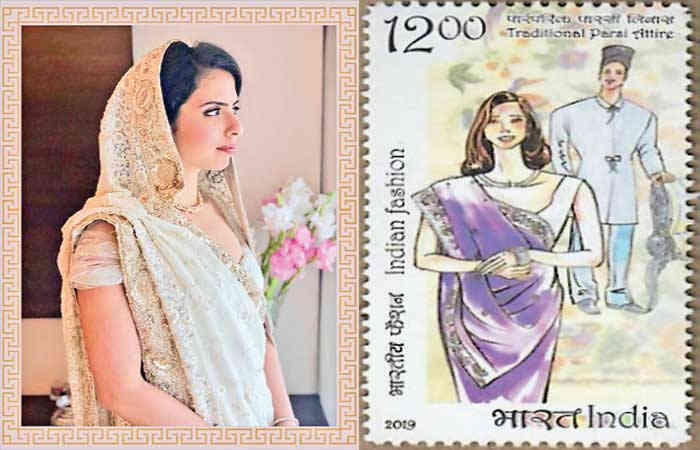
..... That is, even the Indian postal department had to take note of 'Parsi Libas' on its own stamp. Yes, this year our postal department has just released such a fine ticket of Rs. Thus is a whole series of tickets on Indian fashion. But on one of the tickets showing different fashions is the Traditional Parsi dress. Here are Parsi men dressed in Parsi overcoat and black haired Parsi male and light purple sari in light purple color.
On this ticket, the Parsi costume has been presented as an Indian fashion brand ambassador. Because even today, Gara, who is inseparable from the Parsi community, is considered very popular and attractive in the Embroidery Traditional Sarees. The Parsi Gara saree, made of contrasting satin stitch, has a distinctly poetic beauty, especially on bright silks of red, black and purple.
Because in this embroidery the paintings of peacocks, butterflies, flowers, birds and animals are inherently full of livelihood, and not even a single corner of the saree is left empty. This rich embroidery of Gara Saree is originally from the Chinese nut-singing congregations through the Via Parsi community.
Its origin was that in the beginning of the 8th century the Parsis started large-scale trade with China by establishing shipping companies. Their overcrowding of China and Hong Kong increased. In return, they used to buy Chinese craft-crafts. The Persian trade with China from the Khambhat port of Gujarat lasted until World War II. The two closed in the surrounding years, and such business families left Kumbha and settled in Surat.
At that time, the textile business in Surat started as a small household. The handmade silk in Surat was called 'Ghat'. Parsi com led the craftsmen to learn the Chinese silk embroidery, making this silk in Surat. Thus, the Chinese embroidered synergy with the surging 'ghat' silk began, and from this the production of this 'gara' saree began. Originally the handwork embroidery Parsi com started by adding the elegance of lace, net, etc in Surat's 'Ghat' silk has given Gujarat a new fashion gift of Parsi 'Gara' saree.
The Parsi Banu, who was slowly returning to the housework, also began to learn the hail embroidery. It now replaces Chinese designs with designs similar to the Parsi Yazda emblem. These garish sarees gradually began to depict Persian designs, such as herons, birds, roosters, roses in flowers, lilies, lilies, jasmine, etc.
The embroidery painted with silk, cotton or gold color drawings. Some of the precious embroidery even became embroidered with strings. In this embroidery, Surat also added jardoshi work. The word 'jardoshi' is also Persian, which means jar means gold and dozi means embroidered.
Georgette or crepe fabric is more commonly used today for Persian Gari Saree. Georgette is lightweight and easy to wear since it is embroidered with original Parsi gara with silk ropes. A parson could not live without a sari on her wedding occasion or at important festivals. Thus, Parsi 'Gara' is no longer merely an embroidere, it is an identity of Parsi art, culture and tradition. This is called Parsi needle painting.
Comments
Post a Comment
What you think give us your idea about this article we publish your words on our site