- Sign-in-Harsh Meswania
- Ramayana-Mahabharata. These two texts are the two banks of the Indian cultural epic. Brajbasi Lal dived deep into it and found pearls as historical evidence...
Did the Aryans come to India from outside or were they native Indians?
This question has been debated for centuries. Aryans came to India by crossing the Hindu Kush mountain range - the belief was strong. As interpreted by foreign historians, the Aryans came to India from outside and established the Aryan culture either by defeating the original inhabitants of India or by collaborating with them. Foreign historians even claimed that the ancient Indus Valley Civilization had flourished in the Far East before the arrival of the Aryans. After the arrival of the Aryans, oat came into it. So some foreign historians, Indian historians inspired by him, believed that the Aryans and the natives of India together established the ancient civilization of India chronologically.
German scholar Friedrich Max Müller coined the term 'Aryan' for the first time. Before that the word 'Arya' was not associated with Praja. In the Rigveda and later Vedic literature, the word arya is a qualitative adjective. This word was used for the good qualities of a person. In that sense 'Arya' was not a race or a race, but a way of life. Max Müller gave a new theory of Arya Praja, considering the word Arya as a vernacular. After that there were interpretations of Arya culture based on that theory.
In short, the theory of foreign historians that the Aryans came to India from outside was accepted in India. However, many scholars started counter-arguments against that claim during the British Raj itself. Chief among them was Frederick Eden Pargiter. F.E. Parjiter first made an important statement in Ancient Indian Historical Tradition: 'The statement that the Aryans came to India from Central Asia needs to be reversed. It is more correct to say that the Aryans migrated from India to Central Asia'. During that period, some foreign and Indian historians also presented research papers that Aryans were the original inhabitants of India. But research in this direction gained real momentum after independence.
After independence, Indian scholars started challenging the theory of foreign historians-archaeologists after they got the opportunity to think independently, to research, to build independent hypothesis and move in that direction. For the challenge, mere arguments could not stand up, solid research was needed. Such research, on which it can be said that the Aryans were the original inhabitants of India, the Aryan culture flourished and developed only in the Indian subcontinent. The era of this type of research started in India after 1950. The foremost and most important name among such explorers was - Brajbasi Lal.
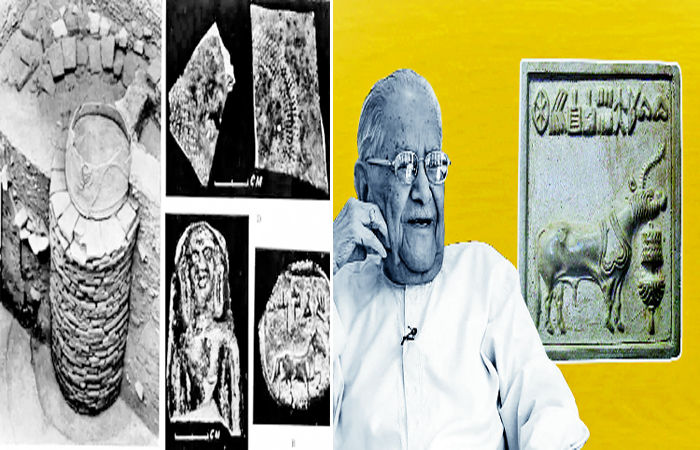
Born on May 2, 1921 in Jhansi, Uttar Pradesh, Brajbasi Lal had his early education in the city itself. Master's with Sanskrit subject from Allahabad University. During his studies, he became interested in archaeology. Being proficient in Sanskrit, he got a job as an assistant in the Archeological Department of the British Government. Under the guidance of Mortimer Wheeler, a British archaeologist and the then head of the Archeology Department of India, he had the opportunity to research the sites of Taxila and Harappa. The lesson of systematic research in archeology was ripe in that era. Along with learning archeological research from foreign methods, he also deeply studied ancient texts written in Sanskrit. The two epics of India, Ramayana and Mahabharata, were not valued by him from a religious point of view, but from a researcher's point of view. Based on the descriptions of the ancient texts, apart from the social condition of that time, they also used to identify the places geographically.
With independence, the Department of Archeology was also freed from the clutches of the British authorities. NP Chakraborty and K. N. During Dixit's tenure, Bibi Lal got an opportunity to conduct research in special projects. The name of that research was - Mahabharata. He discovered the archaeological remains of Hastinapur near Delhi. Collected historical evidence of Ganges and Yamuna rivers. Excavation along the river bank also studied in detail how old the rocks are in the subsoil. He wrote a book based on that research. Many research papers were presented all over the world. Presented the archaeological history of India to the world from a different perspective. Mahabharata is not just a fantasy or an epic, it was the proud history of India - he established through research papers. His scientific method of archaeological research gained wide acceptance. Other Indian archaeologists and historians also got a new direction, a new inspiration.
Bibi Lal headed the Archaeological Survey of India from 1968 to 1972. He did a lot of work during that period on conservation and excavation projects of ancient sites. After his retirement in the 1980s, Bibi Lal took up his most important and controversial project, the Ramayana. Excavations at Ayodhya, Bharadwaj Ashram, Nandigram, Chitrakoot and Shrungapurpur, the places mentioned in the ancient Mahagrantha Ramayana, have collected for the first time ancient-historical documents related to the Ramayana. Foreign scholars considered Valmiki Ramayana as a wonderful epic, but archaeologist-historians did not accept the existence of Ramayana period as a part of human history. The period which Indians refer to as the Ramayana period is called by foreign historians as the period before the ancient Indus Valley Civilization. According to him, there was no significant development in the Indian subcontinent before that.
But by excavating five important places described in the Ramayana, Brajbasi Lal gave scientific-archaeological proof of the existence of Rama. It also changed the course of the social movement in India. Especially since 1949, the Ram Mandir issue was going on in Ayodhya. Just as foreign invaders demolished hundreds of temples and built mosques across the country, so too in Ayodhya, temples were demolished and mosques built - a belief that for the first time found archaeological support. Till now there was only anecdotal basis, now it was mixed with research evidence.
Bibi Lal made another important research around 1985-90 amid popular sentiment that there should be a temple of Lord Shri Ram at Ramjanmabhoomi instead of a structure built by foreign invaders. During excavations around the Babri Masjid, they found imprints of gods and goddesses engraved in 12 pillars. He also proved that the stones used in the pillars were hundreds of years older than the time when the mosque was built. He collected detailed data on the design of the pillars in the old temples of India. In 2002, the Archaeological Committee of the Court was formed. The committee accepted Bibi Lal's theory regarding the design of pillars in ancient temples. Due to this, the archaeological evidence collected by him in the case of Ram Mandir also proved valid. With the research of Brajbasi Lal, Sriram of Ayodhya appeared in a new form.
Foreign historians including the English were not ready to give up their old theory that India had such an old culture! If the existence of Aryas including Raghuvamsa-Yaduvamsa-Kuruvamsa is accepted, then in AD The belief that Aryans came to India 2,000 years ago was discredited. Because the period of Ramayana-Mahabharata is much older than that.
Also, when the Arya people or the word Arya is mentioned around the world, it must also be accepted that Aryas must have gone to other countries or continents from India. If that theory is accepted, the history of the world has to be rewritten. It is established that there was a member culture in India hundreds of years ago. In this situation, foreign historians on the one hand maintained the belief that the Aryans came to India from outside and on the other hand continued to deny the period while describing the Ramayana as amazing and the first epic from the point of view of the story.
After Padmavibhushan Bibi Lal explored the Ramayana-Mahabharata sites from an archaeological perspective, foreign archaeologists, historians and anthropologists began to seriously discuss the existence of the Mahabharata-Ramayana period. Not only this, a new debate arose among the scholars of the country who valued Indian ancient history under the influence of foreign historians. Some scholars were also criticizing him. He was accused of having a strong influence of religious belief on his research, but critics could not deny the ancient evidence found during excavations despite religious belief. In the name of Bibi Lal, who passed away at the age of 101 this month, Mahamula writes about 25 books and 150 research papers.
In his book 'The Saraswati Flow On' in 2002, he logically rejected the theory that Aryans came from abroad. For that, he took the support of ancient Sanskrit texts-manuscripts, and also cited the 50 years of archeology researches he had done on Indian soil. He linked the Indus Valley Civilization with the Saraswati Civilization described in the Rigveda, arguing that the people of the Rigveda were part of the Harappan civilization.
Bibi Lal, an ardent scholar of Sanskrit literature, found the pearls by diving between the two epics of India like the Ramayana-Mahabharata, instead of drawing superficial and hard-to-swallow conclusions that had proved to be great doctrines in ancient India based only on the interpretation of Sanskrit verses.
Bibi Lal was active in several UNESCO committees
His research work was also respected abroad. He worked for many years in various committees of UNESCO. He recognized the importance of ancient places around the world and made recommendations to protect them. Due to his efforts many places like Agra Fort, Taj Mahal, Sun Temple of Konark got World Heritage status. Along with research, he was also active in the field of education. After being the director of Shimla-based Indian Institute of Advanced Study, he also became the chairman of IIT Kanpur. He is credited with the use of modern technology in the field of archeology in India. He advocated new researchers to use technology in archaeological research. During his tenure as the Chairman of IIT Kanpur, he made special efforts for the exchange of experts from both the fields.
Comments
Post a Comment
What you think give us your idea about this article we publish your words on our site