- Gochar-Agochar-Devesh Mehta
- If a ten-year-old child were to fly around the Andromeda Galaxy in a spaceship traveling at the speed of light, he would be sixty-six years old, but forty million years had passed on Earth.
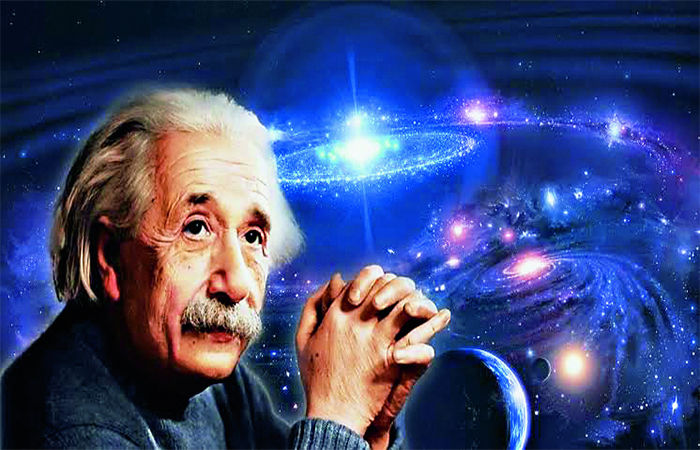
Shining like the sun in the sky of the science world, Albert Einstein, the great scientist who received the Nobel Prize in Physics, introduced the theory of relativity, he also talked about the theory of time dilation. In it he stated that there is no fixed rate of expansion of the universe. All objects in the universe are moving relative to each other and also moving away. It is true that solid matter expands i.e. expands and contracts, but in the same way time also expands and contracts i.e. becomes larger and smaller.
Time does not pass at the same rate for everyone. A rapidly moving observer perceives time as passing slightly slower than a stationary observer. That is called time dilation or dilation. This can be understood immediately from an example. If you shake your wristwatch vigorously, you will notice that its second hand takes a little longer to pass a second. From this we can say that the moving clock runs more slowly than the stationary clock.
Thus a fast moving object appears smaller in the direction of its motion relative to a slower moving object. However, this effect is very subtle. This phenomenon is not visible until the object approaches the speed of light. When Einstein presented the theory of relativity, he explained that space and time are part of a continuum. According to Einstein's mathematics, we cannot experience extra dimensions other than the one assumed by the theories of space.
Famous science fiction writer Arthur C. Clarke has given a beautiful, simple explanation of Albert Einstein's theory of relativity in his book 'Man and Space'. In it, he has given an example to explain this, saying that if a ten-year-old child travels at the speed of light in a spaceship and comes back from a round of the Andromeda galaxy, he will be sixty-six years old, but forty million years have passed on Earth. In 1923, the London humor magazine 'Punch' published a fine poem considering the theory of relativism -
'There was a young lady named Bright,
Whose speed was faster than light,
She set out/went off started one day
in a relative way,
And returned on the previous night.'
Energy to matter G is two different expressions of the same thing. Einstein's famous formula E = mc2 stands for - E = energy, m = mass and C is the speed of light. The same object enables itself to emit a large amount of energy from a nuclear explosion. A consequence of E=mc2 is that a fast moving object seems to weigh more than a slow moving object because as the object's speed increases, its kinetic energy increases and hence its weight also increases. Einstein said that mass gain is one of the reasons why matter cannot travel faster than the speed of light. If the weight of an object keeps increasing with its speed, then it becomes immeasurably-infinite when it reaches the speed of light, and it is impossible because it would require infinite energy to move that much weight.
A similar example given by Arthur Clarke based on relativism is depicted in the episode of Revat-Kukudmi in the ninth skanda of Srimad Bhagavata Mahapurana. Anarta's son Maharaj Revat built a city called Kushashthali (present-day New Dwarika) inside the ocean. Staying in it, he used to rule the Anarta and other countries. Kukudmi was the eldest among his hundred sons. Revati, the daughter of Revatputra Kukudmi, was extremely beautiful and endowed with all virtues. When she became of marriageable age, unable to decide for herself with whom to marry, she decided to go to Brahma in Brahmaloka. He hoped that Brahmaji would find a suitable groom for Revati. He decided to go to Brahmalok with Revati. When Kukudmi took Revati from Yogabal and reached Brahmalok, a dance-music program was being performed by the Gandharvas in the meeting of Brahmaji. The king thought that after the program was over, he would meet Brahmaji and tell him about it. After the program was over, he met Brahmaji and presented his story. With that, the king presented a list of some of the grooms he liked and asked him to tell who he thought was the most suitable.
Brahmaji, listening to him and seeing his list, started laughing and said - 'O Rajan, the speed of time is more wonderful. The speed of time is different in different places in the universe. That little time you waited in Brahmaloka, spent time here, so in time, 27 chaturyugas have passed on earth. Now this list of yours is of no use because they have all died long ago. Not only their descendants, even their gotra cannot be traced. Now you are left with father and daughter. Your kingdom on earth, home and family, friends, gold, wealth-builders have been destroyed. Dwapar Yuga is going on there now. Lord Vishnu is incarnated there as Krishna and Balarama. Balaram is a suitable groom for your daughter Revathi. You get your daughter Revathi married to him.'
Then King Kukudmi and Revati came back to Prithvi Loka with yoga force. According to his experience, it seemed that some time had passed since he came back, but here the 27 chaturugas were changed. There was a drastic change in the seasons, the atmosphere, the shape of human beings, etc. on the earth. As Revati was born in the pre-age, she was taller and larger than Balaramji in stature. So Balramji put a plow on his head, didi made it into the right shape for Balramji with divine power. It is said that 1 day and 1 night of Brahma is equal to 8 million years!
Comments
Post a Comment
What you think give us your idea about this article we publish your words on our site