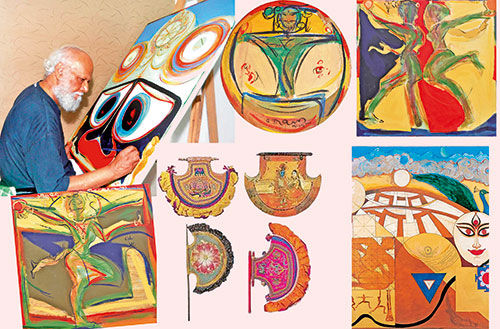
 - Rasavallari : Sudha Bhatt
Expressive Contemporary Art
The art of painting, which has been going on since time immemorial, turned the corner in the European countries of the Renaissance and a miracle happened in the art world. The prominent art of each country developed its own signature art and at the same time made an able effort to recognize and follow the newly blowing wind. Taking on a modern dimension, modern art began to roam the world with the contemporary adjective. Most of the time, if he was bored, he was also labeled as 'Sajjay Nahi Avi'. It was also called 'absurd'. Yes, the word absurd started to be known in literature as well. Paintings range from Pablo Picasso, Leonardo da Vinci, Monet, Van Gang, Michel to Rabindranath, Avanindra Nath, Gagandranath of the Tagore family in India to Nandalal Bose, Gaitonde, MF Hussain, Amrita Shergill, Gemini Roy, SH Raza, Bendre , Ravindra Reddy, Atul Dodia who created their art in that time and place - according to their age and their style, called contemporary i.e. contemporary artists in true sense. One of them, the art journey of Padma Bhushan Jatin Das has been going on uninterruptedly for the past fifty years. This versatile artist dabbles in many fields of art. This instinctive artist who has devoted his entire life to painting has some devadatta qualities; So, Jatindas, who is a devotee of Kaladevi and Saraswati Devi, harbors some ideologies in the depths of his mind, the power of the viewer is more important than the clarity of the picture in the modern style.
A train of philosophy in the paintings of Jatin Das
Originally from Orissa and now a resident of Delhi, Jatin Das found two gurus who encouraged art: Sri Viranchi Narayan and Sri S.B.Palsikar. Gardening, horticulture, dance, singing, playing, writing, painting and many other arts formed Jatin's art. Apart from being an artist, Jatin Das is an avid art collector and art lover. He is active in promoting both traditional and contemporary art through audio-visual medium by establishing 'Kalabhumi' institution. Also, over the past twenty-eight years, he has collected more than six thousand fans, including artefacts related to the fans, within his vast collection of hand fans. This artist, whose paintings are exhibited in museums of the country and abroad, has also written a book titled Jiuari Jiunan Chai. This isolated person who is shy by nature is full of human love. That is why, in his sculptures and murals, he knows how to shape the various parts of the human body with his own unique approach, just like the paintings. Any artist is hailed with true identity by their works of art - so, together with their paintings like their beloved children. Sometimes sticking to the theme, sometimes free and touching various subjects, he has also met the people with his paintings. Tasting what comes to mind, Jatinji, who creates paintings only with the colors of his imagination, does not paint for the sake of exhibitions - once the paintings are done, he organizes exhibitions. Not regretting but keeping a positive attitude, he says 'I am a painter trying to be an artist.'
'I don't want to climb the stairs without getting stuck'
Jatinji also combines etching with serigraphy to explore his artistic interests and personality. His favorite mediums are oil paints, watercolors, ink, acrylics and cones. 'Conte' means a mixture of thick crayon and clay. Apart from the canvas, the characters are also brought to life on a tool like a trowel. His style with a modern approach makes the human figure multi-directional and gives life to the depiction of male-female relationships. Emotions, crisis, anxiety, relationships are exposed from the picture. Their colors are emotional and eloquent. Chained lines, crisp brushstrokes give unique direction and dimension to paintings. Among his several notable paintings is a large painting at the Parliament of India under the title 'The Journey of India' at Mohenjo Dero to Mahatma Gandhi, size 7t68 ft. The subject variety in the long figure is immense. Bengali goddess worship with geometric background, nature, cloud, moon, cosmos, forest, Ajanta sculptures, haloed Buddha, peacock, snake, culture, swastika, Veda Richa, Swaraj movement, spiritual leaders, workers, Indian rebel women against British. Hey! Kanubhai, the grandson of Mahatma Gandhi running along the beach with his stick, is also present here! Dark colors, metaphors, poetics and rich suggestions too! Other paintings depict men and women in search of each other, deities in dancing postures, psychophysical dialogues, sattvic visionary characters and even jnani dancing. Creativity is transformed from inner strength.
An artist who transcends time and space
Among the paintings that lead to artistic obsession are Krishna, Radhakrishna, Sringara, Ganapati, Shakti and a woman conversing with a mirror and the traditional headless torso. Jatinji believes that Shiva Shakti is his inner power – energy. All the characters in his pictures are seen as dancers which becomes natural. After opening the roof, a heavenly atmosphere is visible everywhere. They are not arbitrary. Because they are psychotic, art emerges quickly. Keeping Shiva, the first dancer of creation, and Parvati, the first dancer, in the center, the pictures he made are full of rhythm, rhythm and melody. The natural dance of the universe that nature. Purusha and nature stay in it! That is why creation is created. He has used original colors, avoiding materialism and sticking to pure art. Dark red, green, yellow, black colors emerge when the universal Shivaji dances on one leg and observes in all directions. The dance posture of Tandava and the combination of Shiva-Shakti creates Advaita! Mahadev is seen holding the universe with two hands in a lasarka depicting Jatadhari Trilokeswar. Different postures on the tavdi too! If Shiva has not entered the mind, is such a thing possible? Anilbhai and Mananbhai Relia of Ahmedabad's personal collection-archer archive, the joy of seeing such contemporary paintings as a guest!
Lasarko
Consider the Golden Age of painting when the characters of the work are highly recognizable—both traditional and contemporary.
Comments
Post a Comment
What you think give us your idea about this article we publish your words on our site