One of Steven Spielberg's classic films came out in 1. It was called "Jurassic Park". In which Richard Attenborough was the star. Some will remember. (The movie is too old to be remembered anyway). A scientist separates the dinosaur's scent from the body of a mosquito brewed in yellow. Charged him in the egg. Creates a world of extinct dinosaurs. The film was made from a novel by Michael Freeton. He also earned a record break at the time.
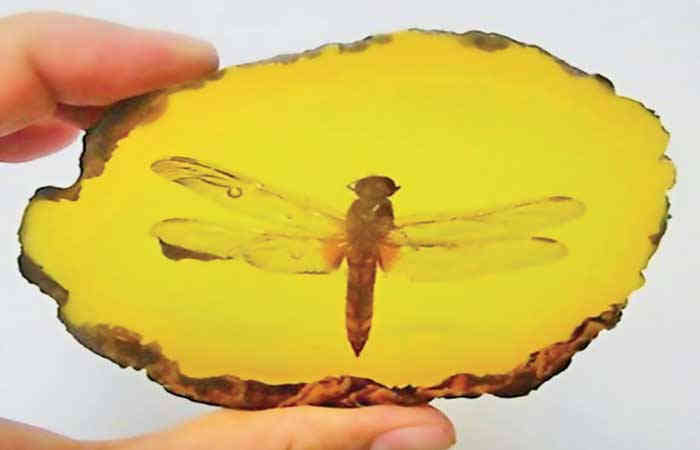
Not the film but the scientific hand shows a yellow amber piece. It is truly considered to be an invaluable fossil. Some of the organisms of the year ago were trapped in this way. Which eventually becomes a corpse for organisms. But for scientists such a fossil is a piece of history.
Why have to remember the fossils of the living organisms in Amber. Recently auction of such priceless twelve specimens is going to be auctioned and in addition, fresh discovery of such priceless amber has been done in the month of May-June. Which is a really rare specimen. A lookout trip to Amber.
Amber Tomb: How To Be?
The question is, how will an organism like Amber be depleted? What's Amber Finally? Is it considered a precious stone or not? Can it be classified as crystal? Amber is a special kind of 'resin' flowing from trees like conical pine. Eventually the frost becomes stiff. When buried in the soil it takes on the form of an ashmi, when the rock is turned into a specimen.
When there is a wound in the trunk or branch of a tree, microorganisms, fungi or parasites, absorb the resin like glue to prevent microorganisms from penetrating into the plant. Which heals the wound. Therefore, bacteria, fungi or microbes cannot enter from there. From the cone-shaped trees, the zircon resin / glue assumes a solid, stone-like structure. Insects are attracted to resin / glue, attracted by the color and odor of the glue. Where it goes.
The organism is completely covered by the secretion of excess resin. Eventually, the organism is completely covered by the secretion of dried resin. Eventually a piece of dried resin falls off and falls to the ground. As it is grounded, it forms a fossil. Sometimes large organisms are sitting on the ground, while at rest they are trapped in a resin constantly dripping from the tree. Amber is also imprisoned in small numbers, from small organisms to small organisms.
Such fossils, preserved in Amber, provide information on ancient living organisms and their environment. Such fossil amber is very valuable in the study of zoology. Some zoologists refer to such fossils as 'Amber Tomb', or Amber's Tomb. Millions of years of ancient lizards, frogs, snails, insects, mosquitoes, birds, etc. have been found by scientists. Who has imprisoned both ancient times and living beings.
Fossil: Saves the past
Amber is also currently used in jewelry making. Which is worth the price. Amber, in fact, is a tree resin. Which has become hard and stoned. Scientists have discovered ancient amber specimens dating back 100 million years. In the past, numerous such specimens were discovered from the Hukang Valley in northern Myanmar. Researchers have discovered ancient amber for ten million years, in which the organism is preserved. Its shape is similar to that of a stranger in Steven Berg's film ET. The organisms had to be incorporated in the zoologists to create a new class for which their appearance and characteristics were so unique.
The head of this organism appears triangular in shape and with two eyes appearing outward. This organism is the most differentiated of all species of organism ever seen. Due to the special type of head and eye structure, the organism could be seen. Due to its incompatibility, a new order called "Ethiocarenodia" has to be introduced in the classification system of organisms.
In addition, preserved fossils have been found in the amber of the egg-laying bird. The head, dock, tail and legs are clearly visible. This specimen is 100 million years old. That is, the bird in the fossil is of the time of the dinosaur. Scientists have named the aquarium-based Oriental Skylark the bird in the sample. It is considered to be the ancestor of today's modern birds, but along with the dinosaurs more than 150 million years ago, this species of birds with its diversity disappeared.
A species of dinosaur blood sucking parasite "flea" has also been found in Amber. Nearly ten million years old specimens prove that blood-sucking parasites existed even in the dinosaur era. An article about the more surprising sample was published in Nature Magazine on May 3. Which holds very important and rare facts for the science world.
Rare Sample: Will Auction Now ...
The dinosaur-era Amber fossils are in the scientists' collection. Out of which twelve semi-transparent Ashmi samples have been put up for sale. While fossil science is one of the rarest and most precious in the world, living in captivity enclosed in a natural resin, preserves its entire body. It's not just for years, even millions of years. Five of the bars are beautifully preserved in inter-fossils. There are winged creatures, millipedes of two spiders, and wanda fossils.
In Britain, Advanced Amber is a science institute called Fitacious Zoologia. Who has assembled a great collection of amazing amber fossils. The science institute is optimistic to research these fossils and get new amber fossils. To meet their needs and raise more funds, this Amber Fitasius Zoologia Institute is poised to raise funds by auctioning up to twelve rare and priceless fossils.
Is the name of a sample. "Real Dragon Blood Amber". Which is transparent and has a golden hue. It is thought that this piece of pheasius period will sell for one and a half million pounds. The second specimen has a long docked organism. Whose ears, skulls and paws look beautifully rooted. The specimen seems to be selling for 2.5 million pounds.
The head of the rehasaur has also been found buried in amber. Which yields 2.5 lakh of the sample. All of these specimens have been put up for auction at West Sussex's Summer Place Auction of Billing Gardens. All specimens placed in the auction have been obtained from the Hukang Valley in Myanmar (Burma). The specimen was obtained decades after excavation by scientists about 5 meters from the surface, decades before the ongoing civil movement in Myanmar.
Rare fossils of marine life ...
Amber fossils, known to be rare, have been found in Myanmar, South Asia. A vision of ten million years of ancient life. In the last few years, samples of frozen frogs, snails, snakes, strange feathers, and some strange species have been found in Amber. The commonality of all of these was that all of these organisms were living organisms on the ground.
Surprisingly, in addition to the organisms living on the ground, sea creatures have also been found imprisoned in Amber. Such rare specimens have been discovered by scientists. How the organisms in the sea may have fallen into the resin of a tree. This has become a mysterious puzzle for scientists as well. It is believed that sea creatures may have been strained to beach sand at the time of heavy tide or oats. Who would eventually become captive in Amber and become a fossil.
In a research paper, scientists write that the incidence of aquatic life in amber is considered rare. Not only this, micro-organisms are also imprisoned in amber which is found in water / water. These specimens are so mysterious that even in determining their age, scientists face various problems.
Where this sample is from. Surrounding it are volcanic rocks. The zircon contained in it contains more than 8 million archaeological specimens from the uranium-based scheduling process. When analyzing the ammonite contained in the fossil, it is found to be from 3 to 1.5 million ancient.
Scientists believe that samples were obtained from a bed of soil. The specimens are likely to be more ancient than the bed itself. Near the place from which the specimen was found, there must have been a sea in ancient times. Perhaps because of a tsunami-like event, marine organisms may have landed and buried in Amber.
Comments
Post a Comment
What you think give us your idea about this article we publish your words on our site