 - Nowadays : Preeti Shah
I want to dance without Bhomia!
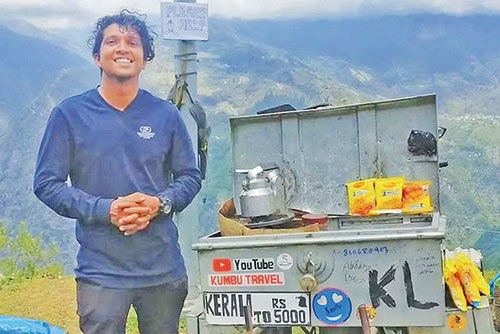
- 24-year-old Jibin Madhu went on a short trip, but his short trip turned out to be very long. In one year, four months and seventeen days he traveled to ten states of India and Nepal...
There is a great passion for travel, but often the financial situation is confusing for those who are passionate about it. They have many desires in their mind. The curiosity to see foreign places has to be kept in mind. It is different for families, but for the youth Jibin Madhu of Kerala says that traveling requires not money, but strong desire. Jibin, a resident of Pala village in Kottayam, is a 'solo traveller'. Jibin, who holds a bachelor's degree in hotel management, has been fond of traveling since childhood. It was his dream to travel all over India. So he decided that after his studies, he would work at some tourist place, and if he collects some money there, he would go to another place. As a child he used to aim to travel around the surrounding areas, mountains, rivers and places of interest, but now he wanted to travel across the states of India. With such a mentality, on April 1, 2021, he left home in search of a job with his Yamaha bike. Along with necessary goods, own clothes and only five thousand rupees!
24-year-old Jibin Madhu set out on a short trip, but his short trip turned into a long one. In one year, four months and seventeen days, he traveled to ten states of India and Nepal. He also wanted to go to Myanmar, but he could not go to Myanmar as its border was closed. He had no experience of such a long journey. He thought that a part-time job would be easy to get, but after meeting fifteen people, he got a job, but at a very low salary. Worked in hotels in Pune and Karnataka from 5 am to 11 pm for just 130 rupees, worked at petrol pumps in many places. While working in a hotel, many travelers listened to him and found work. When Jibin left home, he did not know that he would travel so long. Also the family members were thinking that he changes jobs frequently.
Talking about his experiences, Jibin says that it was very difficult to find work in different places. When he left Madhya Pradesh and reached Uttar Pradesh, he had only one hundred rupees. He saw small food stalls throughout his travels, so he too thought of starting a food stall on his own bike. He had a kerosene stove, some utensils and Matta rice from Kerala. He bought some goods from the street and started making and selling noodles, omelettes and tea. All set on the top box of the bike. He had experience in cooking, so easily started running a food stall. Gradually paper plates and paper glasses were also introduced. It is said that many people who go on a trip on a bike ride 300-400 km a day. runs, but wherever Jibin goes, he stays for weeks at a stretch. Meeting people and experiencing the different cultures of India. His food stall was doing well. Once found there, he used to feed the Keralites with Kerala rice. Started earning five hundred to six hundred rupees per day. He also sent some money to his home after deducting his expenses.
Thanking the people, Jibin says that more than the income from the bike food stalls, he was able to continue the journey with the support and love of the people. Many people gave work, many people gave a place to sleep. Very cold and snowy in Rohtang and Uttarakhand. His tent was normal and there was no sleeping bag, so it was very cold even with clothes on top of each other. That day he covered himself with his clothes. On reaching Meghalaya, the tent was torn. At that time a person from Assam gifted him a tent. With such bitter-sweet experience, the journey went ahead, but in Tawang, Arunachal, his bike broke down and the cost of repairing it was ten thousand rupees. After that, when the bike broke again, he repaired it himself with the help of the military.
To bring his travel experiences to the public, he started a YouTube channel called 'Kumbu Travel', in which he narrates his experiences through videos in Malayalam and Tamil. Tamil people helped him a lot, so he blogs in Tamil language. He used to learn Hindi in North India and blog in Hindi as well. The people of Punjab also helped a lot and he also participated in the peasant movement there. His father Kumbukkal Madhu and mother Usha came to know about his trip to India from YouTube channel 'Kumbu Travel'. The displeasure of the parents subsided a little. Returned home on 17th July 2022 after visiting Tamil Nadu, Andhra Pradesh, Madhya Pradesh, Jammu and Kashmir, Uttarakhand, Meghalaya, Maharashtra, Sikkim, Himachal Pradesh and Nepal. Jibin did not lose courage in spite of any difficulties encountered during this journey. He says, 'Travel is one thing that inspires me to move forward in life. It gives me a sense of freedom and satisfaction.' Wants to travel to many countries including Thailand in the future. For that he prepares himself and the bike. He believes that whatever happens, I will keep the bike food stall ready, which gives me the confidence to reach my destination.'
 Silky indeed, but completely non-violent
- Laisha started a Hatshal unit with an investment of Rs 20,000 from her own savings and Rs 30,000 from friends and family - thus an investment of Rs 50,000.
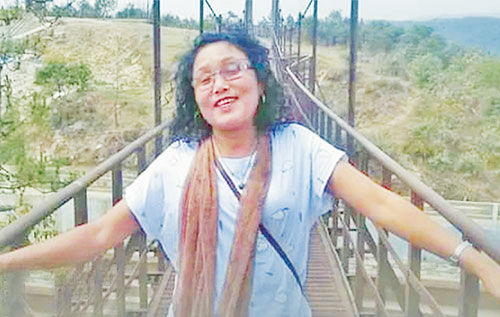
In our country with a diverse culture, each state has its own distinctive features, especially in food, social customs and costumes. How much variety in handicrafts too! But sadly many arts are dying out. As the patolas of Patan have been made by a single family, many of the various types of embroidery in Kutch have become extinct. In Meghalaya too, Ari silk weavers have dwindled. Born into a family of weavers in Meghalaya, Laisha Rimbai taught mathematics at school, but her mother Priscilla Rimbai wanted and insisted that Laisha learn her traditional arts and crafts, especially Ari silk weaving, along with her education.
Inspired by her mother, Laisha started a handloom unit with twenty thousand rupees from her own savings and thirty thousand rupees from friends and family - thus an investment of fifty thousand. Thus, five to six persons in his family knew how to weave. Laysha's mother still knits when she has time, so the beginning was easy for Laysha. Laisha, working as a teacher in Meghalaya's Red Ipnagar village, received an order for fifty eri silk scarves in December 2018. To fulfill this order on time, there was a need for villagers and especially women. He was willing to teach women the art of weaving Ari silk. She went to every house in the village to encourage them. Laysha felt that if these women learned the art, they would find employment, as the raw material for it was abundant in the area, but there were very few persons skilled in weaving Ari silk. He was more interested in other professions. Laisha also wanted to revive the art, but when she persuaded women to learn weaving, they began to look at her with suspicion and some even accused her of profiteering. Finally Red approached Ipnagar Handloom Weavers' Cooperative Society to revive the art and was able to get in touch with a group of women who were educated in spinning and weaving Ari silk. After completing an order of fifty scarves, Laisha began efforts to popularize Ari Silk. The most important thing about Ari silk is that this silk is different from other silks known as non-violence silk or peaceful silk, because it produces silk without killing cochetta or silkworm.
According to the 'Peta' organization, ten thousand coshetas are killed to make one silk saree. While Ari silk is obtained from Samia scindia ricini or Phyllosmia ricini worms, which are fed on castor and cassava leaves. Cosheta is put into boiling water after the worms are removed from it, hence it is also known as Ahimsa silk. This silk is suitable to wear in all weathers. Cools in heat and warms in cold and does not harm the skin. Embroidery can also be done with this silk. Laisha has created a website called 'ariwave.in', from which all the information can be found. They sell scarves, stalls and cloths and use social media to sell, to reach more and more people.
Laisha applied as an entrepreneur in Startup Ecosystem PRIME (Promotion and Incubation of Market Driven Enterprises) Cohort-2 in Shillong to encourage such initiatives by the Meghalaya Government for further expansion of Ari Silk. By that he will be able to take Ari Reshma to Vishwapalak. Laisha believes that incubation at Prime will help her grow her business, involve more women and reap economic benefits, as the demand for Ari Silk products is increasing today. He had recently participated in the World Expo held in Dubai. Today, Laisha sees the UAE as a market. Since this silk is handmade, it is time consuming and also expensive. Today Laisha Rimboi's team consists of ten permanent women weavers and seventy women spinners. These women earn ten to fifteen thousand per month. The difficult task of growing a business between a job as a teacher and taking care of a family is being done with proper planning of time, as the dream is that one day our products will be sold in the global market.
Comments
Post a Comment
What you think give us your idea about this article we publish your words on our site