- Shabda Samhita-Paresh Vyas
- The leader is present at every level of the process but does not delve into the details. It empowers its team members to make their own decisions and carry out their work.
turning the crowd into a fair,
That is my life religion, my life work.
- Narendra Modi
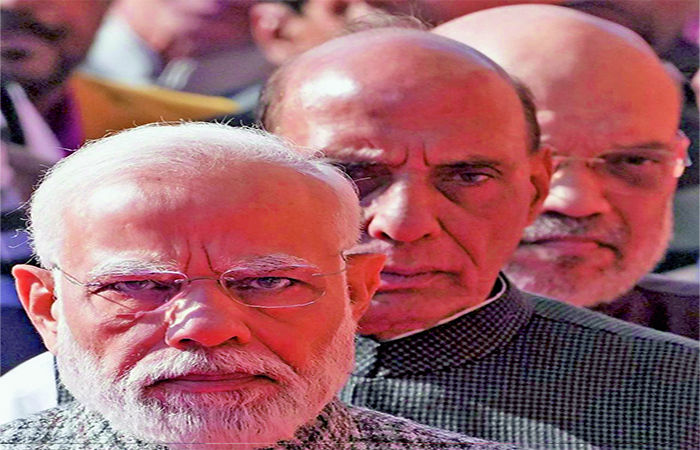
The Law Minister shared the picture on Twitter and captioned it: Leading from the front. This picture, taken at a program to pay tribute to the martyrs on the twenty-first anniversary of the terrorist attack on Parliament in 2001, went viral. The title 'Leading from the Front' describes the characteristics of leadership.
According to the Gujarati lexicon, 'lead' means to guide, to lead, to lead or show the way, to lead, to control or manage movements or actions, to lead in (formulating) opinions, to lead by persuasion, (life) to live, (life) to live, to be first in, to lead, to go or be first. and 'front' means the foremost side, or part, the front, the vanguard, the scene of direct warfare, the forces assembled for a special purpose, the organized political group, the front, the vanguard. In short, a leader who leads himself...
In cricket, if the captain himself scores a century, fills tight fielding and even takes wickets by bowling, then the newspaper writes that the captain is leading from the front. But the true meaning of this phrase is slightly different. Whether a captain or a leader, he himself cannot be ahead everywhere or in all places. This is teamwork. A captain who leads from the front is not only in front but also constantly inspires the team and can also see what challenges lie ahead and how we will overcome them? Who will we use when? And how? The England cricket team has won two consecutive Test matches in the Test match series played in Pakistan. And its captain is Ban Stokes. One or two players were changed from the old team but the team was almost the same. But won. Ban Stokes' aggressive approach was responsible for the win against Pakistan. There is no such thing as risking victory out of fear of defeat. This is leading from the front. A good manager is one who works together when the team is in trouble. A good manager is not necessarily a good leader. A manager has only one goal: to manage, to run. A leader is guided by the way or process of getting the job done and nurtures, nurtures, and develops his team. This is the job of a leader. It should be remembered that this phrase - managing from the front - is not.
A leader is present at every level of the process but does not delve into the details. It empowers its team members to make their own decisions and carry out their work. Leading from the front does not always mean that the leader has to run first. The leader has to see that the one who runs first knows the target, is capable. If the situation becomes odd or dire, they will make adjustments. And yes, most importantly. If there is any problem main hoon na.. it's me, don't worry. A leader who leads from the front thinks from a distance. Formulates strategy. Forms a mould. And he can even kill the one who comes in the way. (Putting a pot is an idiom. It means to throw away, to kill. This practice has taken place in the sense of putting a pot on the pot and giving it to the Brahmin after performing pretashradha.)
In short, leading from the front does not always mean going forward and forward. The mantra of Nelson Mandela, the champion of the abolition of apartheid movement in South Africa was: 'Leading from the back and let others believe that they are in front..' To enable people, they need to move forward.. Then the question comes to be forward or backward? In childhood, the story of Lavari and her cubs was taught. A farmer, his farm and the mall standing in it..The lavery nests with its chicks. One day Lavari went out. When the chicks were in the nest, they heard the farmer and his son. If it is time to harvest the crops, let's call the neighbors and relatives tomorrow. Lavari told the cubs that it was not time for us to go yet. No one really came to reap the harvest. It was decided to call the relatives. They did not come. Jagannath finally in his hands. It was decided that the next day the farmer himself, his household and son would harvest together. Lavari flew away with her cubs. Because the farmer decided to lead from the front and understand that now the work is done. The difference is in two words. 'Go' and 'Let'. Chalo means leading from the front. But this is an old story. The new story is different. A mall stands in the field. And for that the farmer has already planned. Harvester machine has been hired.
He told the son that you should stay on the farm. Have you checked online on your computer to see what the price is? Then an attempt was also made to sell the crops in the marketing yard itself and along with this planning was also done for the seeds of the next crop. Future tillage, fertilizer, water have already been wasted. This is new India. Here the lavari now flies early with the cubs because here the leader is leading from the front..
After seeing the photo, you must have felt that there was no mention of Modi Sahib's leadership in the entire article. But guys..there is no need for it in vocabulary right?!!!
Word Remainder:
'Ten soldiers cleverly led defeat a hundred without a proper leader.'
-Greek writer Euripides (480 BC to 406 BC)
Comments
Post a Comment
What you think give us your idea about this article we publish your words on our site