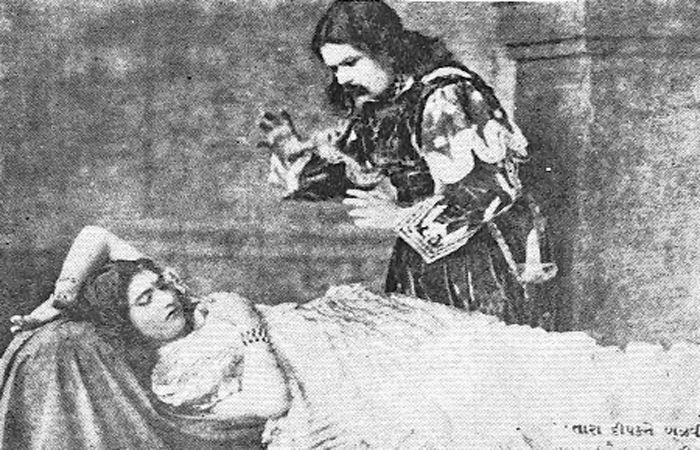
- Seminar of Parijat- Dr. Kumarpal Desai
- At that time these dramas had a very strong hold on the public mind. There was an audience for a new play on the first night itself, and they did not hesitate to spend any amount to see the first play.
One feels the experience of going through the history of Gujarati professional theater while reading an exciting historical story. In those days the play started at night and ended early in the morning. Also, as seen in Gujarati films for a long time, there is a 'tragic' section in the drama and another 'comedy' in between. A three-act play had about eighteen entries, and a play usually had fifty to eighty songs, with some plays having even more.
Today's natyarsik will not even imagine that in the play called 'Sangeet Lilavati' of the Desi Natak Samaj, apart from the songs, chopai and soorthas were also woven and there were a total of 528 verses in that play. At that time, theater organizations used to bind famous poets, artists by signing contracts with them for a certain period of time and if any other organization kidnapped the poet, playwright or artist, they would also file a lawsuit against them in the court. The case of one such claim is interesting.
Poet Mr. Moolashankar Moolani wrote a play called 'Nand Batrisi' and the Gujarati Natakmandali started its rehearsals. Earlier this company's play 'Kamalta' had got a good run, so there was no immediate need to present the play 'Nand Batrisi'. Meanwhile, due to mutual disagreement among the managers of the company, Mr. Moolashankar Mulani bought 'Sri Mumbai Subodh Gujarati Natak Mandali' in the name of his son-in-law Mr. Vishwanath Madhavji Bhatt and at that time Tribhovan Kothari, Chunilal Lakshmiram, Mohanlala, Vitthalalal Bhojak and Petty Master Bapuram Poonjiram, Sri Mumbai Gujarati Natak Mandali were released from the company. Moolashankar joined the company bought by Mulani. As a result, in 1899, another drama company was prevented from writing other plays due to this breach of contract. An injunction was obtained by suing the High Court, so that they could not set up another theater company in Mumbai during the contract period. The famous artist of that time, Mohanlala, also got an injunction from the High Court to stop him from working in Sadarhu Company. As a result, Mohanlal was forced to rejoin the company.
It so happened that at that time there was a need to repair the Gaiety Theater in Mumbai. Where can the drama company afford to sit? So they all went to Karachi on 29th April 1906 and performed a play called 'Saubhagya Sundari' in Karachi. After that, 'Nand Batrisi' was performed in Karachi in 1906 under the guidance of skilled director Mr. Bapulal Nayak based on the work of poet Shamal Bhatt and the play became a great success. These companies mostly staged old dramas with new decorations and character changes. As old films are given a new look today! This attempt was relatively successful and finally on 16th November 1907 it was decided to perform the play 'Nand Batrisi'. At that time Gaiety Theater in Mumbai also had a different look and feel, but it so happened that due to the illness of Jaishankar Sundari, the play 'Nand Batrisi' started a week late, but it received great popularity.
It is a fact that at that time these dramas had a very strong hold on the public mind. There was an audience for a new play on the first night itself, and they would not hesitate to spend any amount to see the first play at that time. On the other hand, some drama lovers prefer to watch the drama by sitting at a certain place and hence spend a lot of money to get their favorite seat. Also, theater lovers used to travel by train and reach the theater on time. Some used to get advance tickets by wire and money order to watch their popular plays. Thus this professional theater breathed on the love of the audience.
While Gujarati plays were performed up to Karachi, some Gujarati actors also performed Urdu and Hindi plays in other regions in the early days of this professional theater and gained good popularity. Theater organizations like Sri Survijay Natak Company, Sri Vankaner Satyabodhak Natak Company went to other provinces and gained a good reputation by performing plays in Urdu and Hindi. Now Mumbai and then Ahmedabad are the places where the play is being performed, whereas at that time these plays were performed in cities like Morbi, Jamnagar, Bhavnagar, Vadodara.
Even in 1941, there were 130 rehearsals of the play 'Muralidhar' written by Haribhai Bhatt and presented in Morbi by the Palitana Bhakti Pradarshak Natak Company. So in Bhavnagar, 300 experiments were done in 1942 of 'Lavkush' written by Haribhai Bhatt. Perhaps if we consider these theatrical experiments, Mother India Theaters (Mumbai) presented the play 'So Touch of Gold' written by Tersingh Udeshi. The founder of this company was also Tersingh Udeshi and he established this company in 1962. The play 'So Touch of Gold' had 1,317 rehearsals and actors like Sohrab Modi, Tersingh Udeshi worked in this company. The play 'So Touch of Gold' was performed in Mumbai, Ahmedabad and Surat.
Tersingh Udeshi wrote an original play called 'Mrigajal' in 1944 after 'So Touch of Gold'. So on 19th June 1966, the third play written by him 'Hira-Manek' was performed. The ticket rates for this play were one hundred, fifty, fifteen, ten and five. This institute which started in 1962 was closed in 1967.
Even at that time, not only mythological or social dramas were performed in the professional theatre, but also dramas based on historical and folktales were written and therefore plays were written especially about the present social situation in those days. An example is Shri Nrisinh Bhagwandas Vibhakar, a barrister who took an active part in literature and political activities. He took a keen interest in bringing about change in the field of theater and the play 'Siddhartha Buddha' written by him was performed in 1914. Sri Mumbai Gujarati Natak Mandal's dramas of that time removed the flamboyance and excess of code and introduced a new progressive thinking.
Shri Nrisinh Vibhakar started experimenting in the theater which no diplomatic thinker or even a writer had done before and a new atmosphere was created in the theater due to the discussion of the then great issues of the country and the burning questions of the society. He wrote plays like Sneh Sarita (1915), Sudhachandra (1916), Madhu Bansari (1917) and Meghmalini (1918) embodying the spirit of patriotism.
The novelty of the themes, literary quality, accurate dialogues and dramatization of these plays caught everyone's attention. In this 'Sneh Sarita' discussing the issue of women's rights, this play attracted the civilized society well. While 'Sudha Chandra' was a drama representing the spirit of Swaraj. In which Bapulal Nayak and Jaishankar (Sundari) acted, he wrote the play 'Madhu Bansari' in connection with the Home Rule League movement. It may be surprising to know, but at that time he composed the play 'Meghmalini' on the subject of awareness about the issues of labourers.
Some influence of this was seen in poet Moolashankar Mulani rejoining Sri Mumbai Gujarati Natak Mandali. He wrote two plays 'Dharmaveer' and 'Kalyanrai'. In the play 'Dharmaveer' there was an echo of home rule and the environment of Swadeshi. Hence the censor did not allow it. While the play 'Kalyanrai' was adapted from Alexandre Dumas' 'Count of Montecristo'.
From 1910 to 1940, about one hundred playwrights wrote more than 300 historical plays which were performed on stage by 76 theater organizations. On July 25, 1940, the 'Jana Khel' was started for women only. Many such exciting incidents are to be found in the history of our commercial theatre.
Manzrukho
In the famous soap manufacturing company E. H. An energetic young man named Little joined as a salesman. His company was very famous in America. The price of his soap was lower than other soaps and the quality was higher, even though he was not getting orders, he thought that there must be some fault in his way of communicating with the customer or that he was falling short in proving the suitability of the company's product. Can't explain the benefits of using this soap. He pondered the reason behind the very few orders he was getting, but could not find a reason.
Hence the young salesman E.A. Little tried a new approach and went to the shopkeeper and asked, 'Look, I have not come to you as a salesman for a famous company, but as a mentor. I don't want to sell soap but need advice. I want to ask that you kindly tell me what fault you find in my soap. I don't mind at all.' After listening to his frank talk, the shopkeeper started showing him his defects, someone would go to another place and ask the shopkeeper that 'You have such a large business. You have several salesmen. So tell me based on your experience in what I fall back on them.' As a result of which E.H. Little proved so adept that he became the highly paid president of the world's largest soap manufacturer.
Revelation of the moment
'Dhun' is the foundation of human achievement. Nelson Mandela was so desperate to break free from slavery to white rule that he spent 18 of his 27 years in prison in a small hole on Robin Island. Had to sleep on the floor and get a dollar for a toilet. Black labor had to be done in quarries. One was allowed to receive one paper every six months and one visitor for thirty minutes once a year. Despite this, his desire for independence did not diminish in the slightest.
Albert Schweitzer felt a sense of service, playing the piano in Paris to raise money for a hospital he built in the Congolese jungle. On receiving the Nobel Peace Prize, he was happy that the money went to a hospital for African patients instead of his own achievement. That's it, it's called a tune. If it rides on the head, it wears the crown of achievement. Such melodies give concentration. The society laughs at the one who has such a tune, but after seeing his success, bows down and salutes him.
Comments
Post a Comment
What you think give us your idea about this article we publish your words on our site