- Management-Dhawal Mehta
- Now power is not given on the basis of position but on the basis of knowledge. The era of teamwork and networking has arrived
Prior to the rise of Ma Hiti Samaj, company management systems were owner-centric. Power flowed from the top down. German sociologist Max Weber named these top-down systems in which authority flows from the top down and the work done in the company (which is called reporting in management parlance) goes from the bottom up as 'bureaucratic system'. In bureaucratic systems there is a lot of emphasis on two things. A thick forest of rules governing discipline (i.e. obedience) and performance and governing employees. Also, in such systems, the boundaries of each department, division or section were strictly followed. If each department, division or section did not follow the boundaries of their rights and authority, conflict would arise between their heads. The head of one section or department used to tell the officer of another section or department that in some matters our section or department has to take a decision. Why did you cross our border? Disputes between police station chiefs over whose border the crime has taken place are ongoing. But such conflicts are not open in companies. He plays the 'dirty politics' of victory or defeat. In every system of the world, if the power or influence of one department increases, the heads of other departments do not sleep at night. Max Weber called this type of bureaucracy 'machine bureaucracy'.
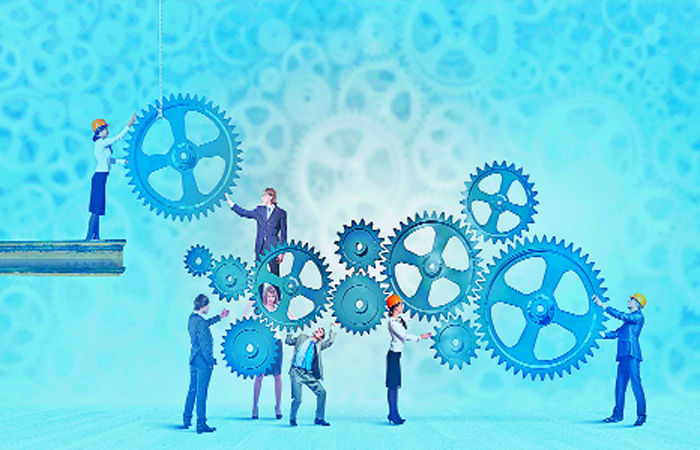
In old systems, power was and still is centralized in the company headquarters. But in postmodern companies, real power has fallen into the hands of networks connecting divisional or departmental boundaries through electronic communication. An individual's greatness or skill or Magroobi in the company, which was earlier talked about as a 'hero', has now fallen into the hands of networks and teamwork. The mistrust between individuals in the traditional management structure is now less in modern management and the importance of mutual trust (trust) and commitment in the management has increased. However, most of the company heads still continue to flatter their subordinates. In English this is called 'sycophancy'. In many companies, subordinates flatter their superiors and praise their decisions, but when the subordinates do not like the boss's decision, they deliberately delay its implementation or do not start work on it. This is called sabotaging in English. The head of the General Electric Company of America created a boundaryless organization in this huge company and made his company sky-high.
Custom systems
Today's companies are making many changes in their management systems. Even knowing the names of these new types of organizational structures will make you dizzy. Spider economy, matrix organization, cluster organization, shellrock organization, chaotic organization, secular organization, modular organization, dynamic networked organization, intelligent organization, learning organization, empowered organization, horizontal organization, cornzocium, flat organization, empowered organization etc. This list can be further extended. One criticism of these new types of systems is that their names may be fancy, but behind them all lies a hierarchy. The argument against this is that whatever the type of management, there must be leadership behind it and this leader must have more power than other employees. Even though knowledge works are increasingly dominating workers or laborers in the current systems. But among these knowledge works there may be a hidden super knowledge worker (genius) and his decision has to be implemented by others. Its authority will be greater than other knowledge works. His authority is not based on position but based on knowledge.
Cross Functional Teams
Cross-functional or cross-disciplinary teams are increasingly important in any type of organization. In the academic world too, cross-discipline i.e. exchange between different disciplines and research and teaching is gaining importance. New disciplines and new approaches are discovered by combining different technologies or disciplines. E.g. Biology and technology together form biotechnology, astronomy and physics together, astrophysics, biology and chemistry together, biochemistry, sociology and psychology together, social psychology, ecology and economics together, economics, geography and politics together to form the new discipline of geopolitics. .
Comments
Post a Comment
What you think give us your idea about this article we publish your words on our site