- Hotline-Bhal Chandra Jani
- Building a satellite is a big challenge, so launching it after building it is also a big challenge. India has now successfully overcome both these challenges.
Indian Space Research Organization (ISRO) has replaced Kamau Dikra. After doing successful work in the rocket and satellite sector in a short span of time, ISRO is now competing with the top space agencies of the world. In 2017, the Indian Space Research Organization (ISRO) created a unique record by launching 104 satellites simultaneously through the PSLV rocket on 15 February. The rocket carried 3 satellites of India and the remaining 101 satellites of countries including America. All these satellites were placed in a fixed position at a fixed time in a 505 km high orbit.
Indian astronomers have so far successfully overcome many challenges in space exploration making the country's communication system powerful. ISRO has developed technology to send satellites into space at minimum cost and has started using it on commercial scale. As a result, India has become an important and strong partner in the space research market and along with this, it will have the opportunity to do significant work on the research front as well as sending satellites into space. ISRO is also going to announce the launch of a spacecraft to Venus.
India launched the first satellite 'Aryabhat' in 1975. But its launch vehicle was Russian and the launch also took place from a Russian spaceport. Rohini, launched in 1979 by Satellite Launch Vehicle-3, was the first satellite to be launched from India. Since then till date India has registered various records of putting satellites into orbit. This record is not easily broken. ISRO has launched a total of 226 satellites, including 179 satellites from other countries.
Earlier in January 2018, out of 31 satellites launched by ISRO before landing, 28 satellites were foreign. ISRO earns a lot for launching foreign satellites. Space projects are usually very expensive and long-term. India's space projects are long-term, but not expensive. On the other hand, ISRO is making a lot of money by launching foreign satellites. Antriksha Corporation was established in 1992 to sell various services of ISRO. This corporation now makes regular profits.
During the five years from 2011-12 to 2015-16, Atriksh's turnover has increased from Rs 1,181 crore to Rs 1,924 crore. While in this period the income of Atriksha Corporation has increased from Rs 171 crore to Rs 209 crore. In the period of five years, Antriksh's total earnings were recorded at 936 crores. Space profits are not skyrocketing like corporate companies but on the other hand there is no longer a loss situation.
In 24 months from January 2014 to December 2016, ISRO launched 44 foreign satellites. Against this, it had made an income of 693 crores in that period. That is, ISRO earned an average of Rs 15 crore per satellite. American private company Space-X also does launching work. But its charge per satellite is 20 times more than India. That is, when India used to charge Rs 15 crore for launching a satellite, the price of launching a satellite of Space X was approximately Rs 300 crore. Under these circumstances, there is no wonder that countries including America are launching near India.
Building a satellite is a big challenge, so launching it after building it is also a big challenge. India has now successfully overcome both these challenges. A total of 9 countries in the world have the facility of launching. As a result other countries have to come to India for launching. Although America-France has its own launching facility, it prefers to use India's cheaper and safer service.
Launching satellites has now become a big industry. In America, private companies like Amazon and Space-X have developed their own rockets and are eager to take advantage of this market in the future. Because the launch in the coming days will not be limited to just the satellite. Journey to Moon and Mars is going to be held. ISRO has so far launched 209 foreign satellites from 28 different countries.
When India started launching foreign satellites in 1999, only 2 foreign satellites could be launched that year. That capacity has now increased a lot. In 2017, India put 130 foreign satellites into orbit. Even abroad, India has so far launched the most 125 satellites by America alone.
One thing to note is that India's satellite program is entirely non-military and home-grown. Countries like Russia and the US first developed missiles and rockets for military use and then used them for non-military purposes. This meant that they had developed complete rocket technology decades before satellite technology was developed. The progress made by the Germans in the field of rocketry during World War II proved to be very beneficial to America and other countries. Other countries like Japan and Israel make rockets based on American designs. In this way, the path of our scientists was more difficult. He had to develop everything at home one by one so our achievement is more commendable.
In the context of the ambitious international plan to deploy a number of communications satellites in near-Earth orbit in the coming decades, cheap and reliable rockets will be needed. The business of launching satellites is very expensive. India can launch satellites at low cost. So it will be able to establish a position in this international market. The recent failure of two Chinese rockets does us no harm. What India has learned is that the business of launching satellites requires a lot of precision. Successful launch of 104 satellites by rockets of a single design is enough to place us in the international market. Rockets made by ISRO are very cheap. To put it in simple words, for the work done by Indian rocket for 1000 rupees, China, America or Russia spend 5000 to 6500 rupees. India can send satellites into space at the lowest cost in the world. Now after the successful flight of GSLV rocket, India has clearly established its position in the satellite business.
With this axiom of ISRO, India has also left Russia behind. Russia has so far launched 37 satellites simultaneously, while ISRO has set a 'world record' of launching 104 satellites simultaneously.
The question is, when did ISRO's glorious journey begin? India's Mangalayan mission, which launched in November 2013, was Asia's first successful Mars orbiter. In fact, the world was forced to take notice of this space program. The probe reached the Red Planet (Mars) at a cost of just $74 million. In fact, the space travel thriller 'Gravity' cost 100 million dollars to make. This success earned Mangalayan India's new Rs. 2000 note has got pride of place. Ms. Rajeshwari Pillai Rajagopalan says that the Mars mission was not just a "sound and light" show. This led to India being considered as a reliable space power and thereby reaping many economic benefits in the big business of launching satellites. Till date, India has launched 79 satellites from 21 countries, including satellites from major companies like Google and Airbus. According to government figures, by launching such satellites, India has saved at least Rs. Earned 157 million dollars.
Satellite itself also has a huge commercial value. Today, the worldwide business of launching satellites alone is worth $121 billion.
In November 2013, ISRO's Mangalyaan mission (Mars Orbiter Mission - MOM) was completed for just 7.30 crore dollars. At the same time, America spent 670 million dollars behind NASA's Maven Mars mission. If we talk in detail, one and a half crore dollars are spent to launch ISRO's PSLV rocket. While America spends a quarter of six million dollars to launch a satellite through Falcon-9 rocket of Musk's SpaceX. Russia spent $90 million on its Proton rocket and $140 million on Ariane Space's Ariane-5 rocket.
It should be noted here that India's Department of Space was allocated one and a half million dollars last year. For the same period, NASA was allotted two and a half billion dollars. Thus ISRO is doing very successful work even in a low budget.
ISRO has some limitations. As such, India can launch a maximum satellite weighing only 1.2 tonnes through the PSLV rocket. from that
ISRO has to rely on European rockets to float the heavier satellites into space.
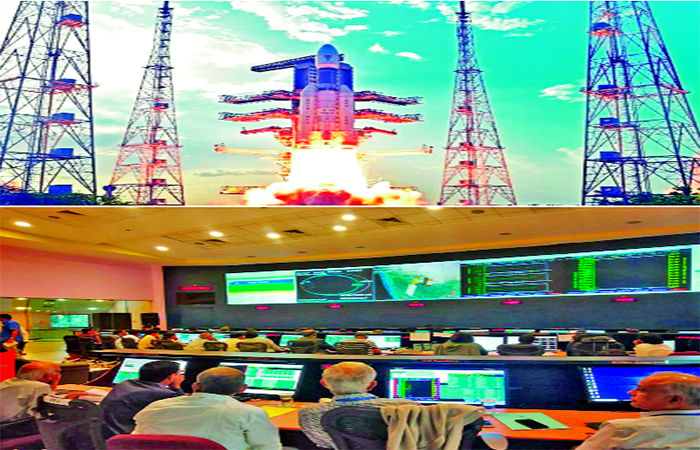
Now, going further in this direction, ISRO has developed GSLV-3 rocket and has been able to float a 4 tonne satellite at an altitude of 36000 km.
A good remote sensing satellite can provide important information about Earth's resources. A satellite can take a detailed picture of the Earth. These images are also useful in various human activities. Such a picture can be taken from an airplane, but it is not economically feasible for a large country like India. Weather can be predicted through satellite images, flood or drought prone areas and their severity can be known through satellite, flood or drought prone areas and their severity can be known through satellite. It is helpful in finding minerals hidden underground. Satellites also provide information about water resources. Satellites can predict if a volcano is about to erupt. Apart from this, human activities like town planning, afforestation, pollution and destruction of forests can also be monitored through satellite. For all these reasons satellite imagery is very important and has a large commercial market. Some of these satellites launched by ISRO also have spying capabilities, but they are not used for spying. Such is the commercial importance of this satellite that ISRO has formed a separate corporation, named Antriksha Corporation, for the commercial aspect of its images.
What do we have to do now? The first requirement is to analyze the images obtained by the satellite in the least time and use them knowing where they are most needed. To satisfy our communication needs in the future we must acquire the capability to place satellites in stable orbit. To place a satellite in a stable orbit, it has to be placed 36,000 km above the earth. So the last stage of the rocket would have to develop a technology that would be more powerful without increasing the weight and would require a cryogenic engine fueled with liquid hydrogen and oxygen.
As far as the satellite is concerned, the design made by our scientists is very accurate and modern. We must now look at other uses of satellites. India currently has all the technology it needs, but not the resources it needs. India's progress in space is remarkable. Now we can say for India that 'even sky is not limit for India'. If India now lays its solid foundation in the field of space science and makes serious efforts, it can grab a good share of the billion-rupee market of launching satellites in space.
The satellite launch market was estimated to be $20,000 crore annually in 2022. This market is growing at an annual rate of eight percent. Russia's Glav Cosmos satellite launch organization charges about a billion rupees per satellite. The cost of the European Union's Ariane rocket is around Rs 190 crore, compared to the cost of India's satellite carrier rocket of Rs 75 crore. Thus, India can compete commercially in this sector.
Comments
Post a Comment
What you think give us your idea about this article we publish your words on our site